Showing posts with label speaking. Show all posts
Showing posts with label speaking. Show all posts
Mar 15, 2023

Feb 28, 2023
B1 Cambridge Preliminary Speaking Test - Parts 3 + 4
Part 3: Talk together for about 2-3 minutes. The examiner will describe a situation.
- Talk to your partner and show an interest in what your partner says.
- Give suggestions and ask your partner questions*, including all pictures. *, How /what about you? / Do you agree? / What do you think?
- Try to speak for an equal amount of time.
- If you don't remember a word, explain it in simpler terms.
- If you don't understand a word your partner uses, you can ask what it means.
Here is an example:
A young man works very hard and has only one free day a week. He wants to find an activity to help him relax. Here are some activities. Talk together about the activities he could do and say which would be the most relaxing.
.png)
Part 4: You will return the picture to the examiner who will ask you to talk about the previous topic. In this case, relaxing. Here are some possible questions:
- What do you do when you want to relax? (Why?)
- Do you prefer to relax with friends or alone? (Why?)
- Is it important to do exercise in your free time? (Why?/Why not?)
- Is it useful to learn new skills in your free time? (Why?/Why not?)
- Do you think people spend too much time working/studying these days? (Why?/Why not?)
Feb 21, 2023
Speaking B1 Cambridge Preliminary
Part 1: Personal information. Talk to the examiner, not your partner. Give FULL answers. Know how to SPELL your name. (2-3 minutes)
Part 2: Talk about a picture. Each student will get a picture to talk about. Talk about everything you see: people, clothes, colors, weather, surroundings, time of day...(2-3 minutes).
 |
| This picture shows people learning a language. |
.png) |
| This shows people at a party. |
Feb 15, 2023
Storytelling: The Snake Bite
What would you do if you were in this situation?
How do you think this story will end?
How do you think this story will end?
What ending would you give the story?
Now create a story that begins with this sentence:
The island didn't look far away, and I felt sure that I could reach it.
The island didn't look far away, and I felt sure that I could reach it.
Jan 31, 2023
WRITING B1: the ARTICLE
In Part 2 of the WRITING test, you must choose to write an ARTICLE or a story of ca. 100 words. An article is a text that expresses your opinion and knowledge.
Remember the 3 parts to writing:
The introduction should catch the attention of your reader. You can ask a question or give a general opinion.
The body is where you develop your ideas and relate them to personal experiences and opinions.
The conclusion is a recommendation and a summary of the main points. Readers should feel they have learned something.
The introduction should catch the attention of your reader. You can ask a question or give a general opinion.
The body is where you develop your ideas and relate them to personal experiences and opinions.
The conclusion is a recommendation and a summary of the main points. Readers should feel they have learned something.
Before writing, ask yourself:
1) What do I have to write about?
2) Who is going to read my article?
Look at this exam task.
You see this notice on an English-language website for young people. Write your answer in about 100 words on the answer sheet. (Remember that it's better to write at least 100 words; better more than less.)
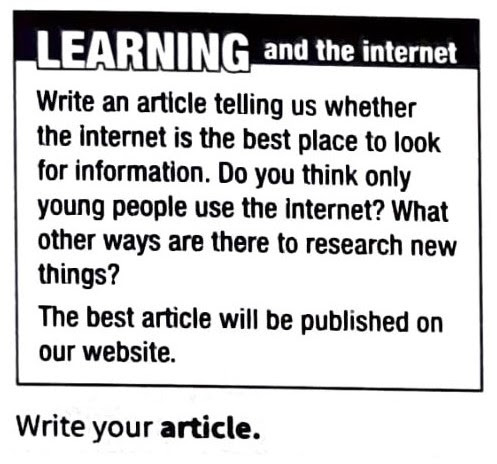
Notice that there are 2 questions that must be answered.
Read this sample answer:
Read this sample answer:

Has the student answered both questions correctly?
Does he give examples and opinions?
What could be done to improve this article?
When YOU write YOUR article, use your own words. Try not to use the same words as the text.
Try substituting the underlined words with similar meanings from the list below.
Does he give examples and opinions?
What could be done to improve this article?
When YOU write YOUR article, use your own words. Try not to use the same words as the text.
Try substituting the underlined words with similar meanings from the list below.
teenagers make find out about willing
goes online try to find details searching for
goes online try to find details searching for
Like the email, the examiners are judging:
• Content – Have you done what you were asked to do?
• Communicative Achievement – How appropriate is your writing style and tone for the task, and its intended audience? Was it easy to understand?
• Organization – Does it have a logical order and paragraphing? Do you express your ideas clearly?
• Language – How good and accurate are your vocabulary and grammar?
Grammer to Use;
Passive - The internet is considered the best place to find information.
Passive - The internet is considered the best place to find information.
Modal verbs - It might be best to stay home.
Conditional - If I were you, I'd stay home and study.
Relative clauses - I know someone who speaks four languages fluently.
Wish - I wish I could travel more often.
Phrases to involve the reader:
Conditional - If I were you, I'd stay home and study.
Relative clauses - I know someone who speaks four languages fluently.
Wish - I wish I could travel more often.
Phrases to involve the reader:
- Have you ever thought about…?
- How would you feel if …?
- What would you think of…?
- Are you one of those people who …?
- If the answer is …, you should….
- What would life be like if…
- Just think for a moment…
- Just imagine…
Use extreme adjectives instead of intensifiers:
very good = awesome, excellent, fantastic, marvelous
very bad = awful, terrible, horrible
very good = awesome, excellent, fantastic, marvelous
very bad = awful, terrible, horrible
big = huge, enormous, gigantic
cold = freezing
angry = furious
Use adverbs importantly, surprisingly, absolutely, suddenly
Develop your points
Another advantage of ...
On top of that…
What is more, …
Above all,,,
The reason I think this is…
The reason I feel this way is…
Let’s start with …
Some expressions for giving your opinion (SPEAKING or WRITING)
In my opinion, …
As far as I am concerned, …
Speaking personally, …
From my point of view, …
As for me, …
My view / opinion / belief / impression / conviction is that …
I hold the view that …
I would say that …
It seems to me that … / It is my impression that....
I am of the opinion that …
I am (was) under the impression that …
I have the feeling that …
My feeling on the subject is that …
I have no doubt that …
I am sure / I am certain that …
I think / consider / find / feel / believe / suppose / presume / assume / guess / reckon that
I bet that ….
It goes without saying that …
Justifying opinions
because…
due to the fact that ...
the reason is… / the main reason is... / that's the reason why ...
the reason I believe that is…
the facts suggest…
the evidence shows…
taking into account what I have seen…
seeing as how....
on account of....
In view/light of the fact that....
Making recommendations and suggestions:
it would be a good idea to…
Wouldn’t it be better to…?
Why don’t we…?
What / How about… ?
Shouldn’t we… ?
Let’s consider…
Why not… ?
For more expressions click on this link to LBA Life
May 30, 2011
Subscribe to:
Posts (Atom)